
“It’s Hip to be Square”
– Huey Lewis
07.13.2026
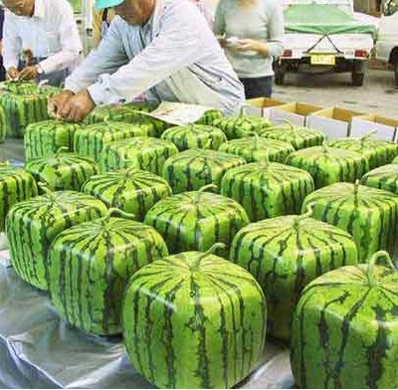
In a Freaky Friday post on social media, we highlighted square-shaped watermelon produced by farmers in Japan. These watermelons are grown inside square tempered glass boxes while they are still small on the vine. As the watermelons grow, they conform to meet the constraints of the box. This simple solution addresses two major problems in the melon industry.
First, these cubic watermelons are less likely to roll, making them easier to stack, ship and store. Secondly, these melons fits perfectly inside the small, compact refrigerators in Japan.
Innovation is sparked by thinking outside the box (or inside of it) to find new ways to solve real problems.
This innovation provides astounding benefits:
- Shipping Efficiency: Simple mathematics show that having a square-shape compared to a round-shape, eliminates ~48% of wasted shipping space per melon and increases packing efficiency by ~92%.
- Product Integrity Efficiency: The flat surfaces of the melon distribute weight and pressure evenly, thereby reducing bruising. The small size can easily be refrigerated to prevent spoilage and preserve quality.
- Packing Efficiency: The shape itself provides structural support, thereby eliminating the need for additional packaging, protective cushioning or restraints.
- Space Efficiency: Grocers and warehouse can increase inventory density by stacking melons higher and more securely, enabling taller and larger displays.
Seems like a no brainer, right? Well…it’s not so simple. The downside is significant.
- Cost: Square watermelons typically cost between $100-200 per melon, which is a 40-fold increase in cost to the consumer compared to a standard $5 watermelon.
- Taste: Since the melons are harvested unripe so they can keep their shape and have a shelf-life of up to 6 months, the melons are firm, pale in color and not very sweet.
Who wants to pay $200 dollars for a tasteless watermelon? I’m upset when I spend $5 on one that is tasteless.
While the idea is innovative and the design solves real business constraints, the ROI just doesn’t make good business sense. I appreciate the niche market for ornamental and novelty gifts, but I wouldn’t advise building a business solely on square melons. I do, however, encourage the mindset behind them: innovation is sparked by thinking outside the box (or inside it) to find new ways to solve real problems.
Sources:
- https://www.whataboutwatermelon.com/index.php/2009/07/how-and-why-square-watermelons-are-made/
- https://www.buzzfeednews.com/article/mbvd/japan-begins-selling-cube-watermelons-to-customers-overseas
- https://www.packagingdigest.com/sustainability/square-watermelons-has-sustainability-gone-too-far-
It’s a good idea, but. . .
06.03.2026

Is it patentable?
Not every idea needs a patent – but every valuable idea deserves a strategy.
The Poinsettia King
12.12.2025

The Rise and Fall of the Paul Ecke Ranch
The history of the Ecke Ranch is a perfect depiction of the benefits and risks of relying on trade secrets to protect your business. A trade secret is confidential business information that gives a company a competitive advantage over others. Unlike patents and trademarks, trade secrets do not have a formal registration process, but companies must take active and reasonable steps to maintain their secrecy.
AI & the Mental Health Crisis
05.15.2025
The Illusory Effect At Work
In recognition of National Mental Health Awareness month, let’s explore three ways Artificial Intelligence (AI) is impacting the mental health crisis by enabling early detection, personalizing treatment plans and reach more people than ever before:
Serendipity
04.03.2024

discovering Something Good Without Looking For It
To quote Jeff Bezos, ”There’ll always be serendipity involved in discovery.” So, keep innovating and experimenting, you never know what you may find.

INNOVATION & IMPACT
Part IV – It all starts at 45
10.02.2024

The thing is…45 is when things start to get good for women – or at least it did for me. At 45, we enter a space of empowerment. The fear of judgment diminishes, and we become more confident and secure in our identities.
Part III – Cauliflower Rice
01.25.2024

According to Harvard Business Review, companies who have leaders who possess both inherent and acquired diversity traits out-innovate and out-perform other companies[ii].
Part II – Automatic Devices
05.23.2023

“We must consider, employ, and engage people who do not look, live, or behave the same. It is imperative to the evolution of technology that we be more inclusive. . .”
Part I – Crash Testing
October 20, 2022

“Diversity of thinking and experience is essential to advancing technology. Inventors must not only think outside of the box but look at the box from various perspectives.”